





 Trap
 Normal
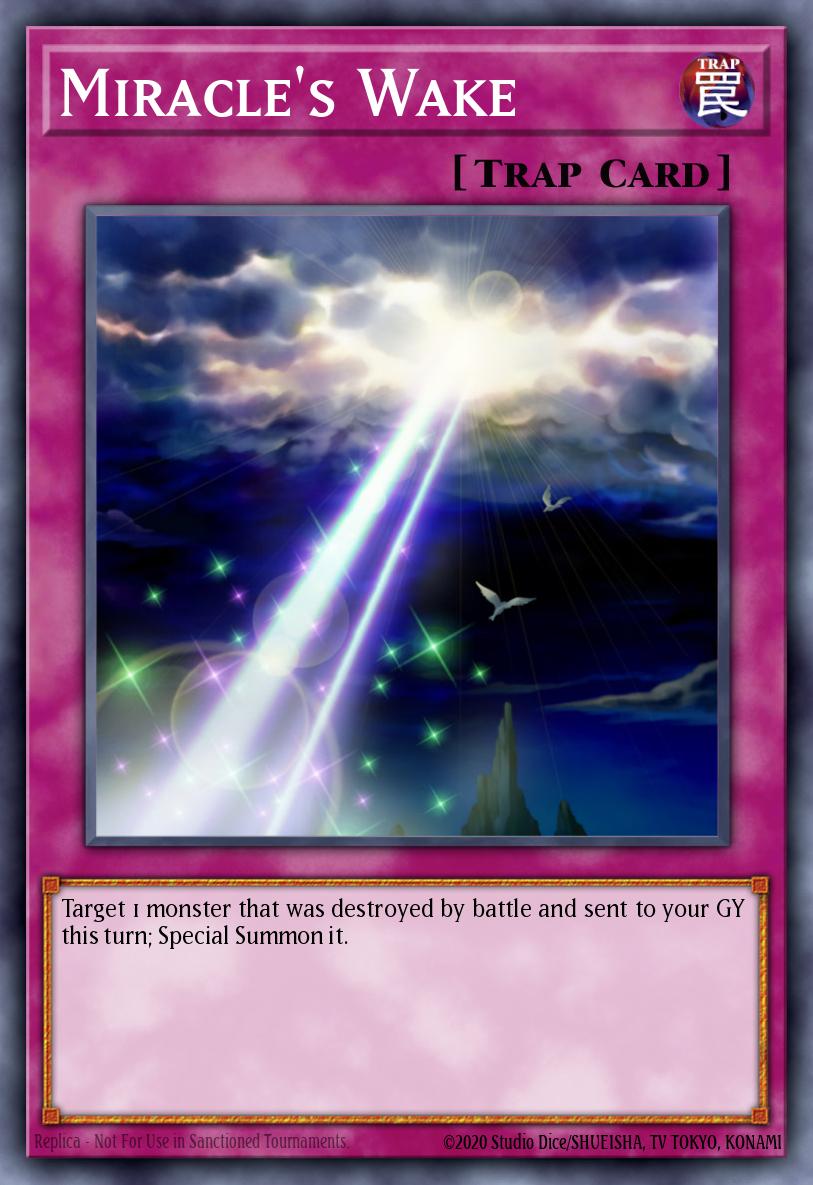
Miracle's Wake
View:
2695
Target 1 monster that was destroyed by battle and sent to your GY this turn; Special Summon it.
Miracle's Wake — Power Evaluation
Final Score: 31 ± 6 · Confidence: Medium
- Intrinsic: 35 · Deck: 32 · Meta: provisional
- Primary role: Recovery / Recursion · Secondary: Utility
Why it scores here
Miracle's Wake recovers monsters destroyed by battle in your GY, but its value is narrowly conditional on a specific setup happening in a single turn. While it prevents resource loss in battle-focused decks, it does not generate advantage, offer disruption, or extend combos. The card trades one trap slot for salvage of existing resources, making it a defensive tech piece with limited applications across the meta. No combo data prevents confirming whether this actually enables consistent lines in practiced decks.
Axis scores
| Axis | Score | Evidence |
|---|---|---|
| Accessibility | 25 | Requires a monster to be destroyed by battle and sent to GY in the same turn—highly situation-dependent and not searchable. (inferred) |
| Combo & Conversion | 15 | No combo board includes this card; recovery on its own does not enable new lines or board extension. (inferred) |
| Resource Economy | 50 | Trades 1 trap card for 1 monster recovery—roughly even economy; prevents loss but generates no advantage. (inferred) |
| Effect & Interaction | 5 | Provides no disruption, negation, removal, or go-second capability; purely defensive salvage. (verified) |
| Material Utility | 0 | Trap cards cannot be Normal/Special summoned or used as material; zero body utility. (verified) |
| Resilience & Flexibility | 20 | Activation requires battle destruction same turn, creating a narrow window vulnerable to play-around and opponent-dependent execution. (inferred) |
| Deck-Building Efficiency | 35 | Runs as 1-of only across all 19 decks; niche tech with questionable deck value compared to other recovery options. (observed) |
Calculation
Weight profile: Recovery / Recursion primary role. Intrinsic ≈ 35, Deck ≈ 32, Meta = provisional. Modifiers: niche_tech_inefficiency (-2). Final formula: 0.40*Intrinsic + 0.60*Deck
Strengths
- Can recover large bodies destroyed by battle without additional cost
- Generic text works across multiple archetypes (13 distinct homes from sample)
- Prevents resource loss from battle destruction in reactive situations
Weaknesses
- Highly situational; requires battle destruction to occur in the same turn
- No disruption or offensive capability; purely defensive salvage
- Does not generate card advantage; trades trap slot for recovery
- Opponent-dependent effect; easily played around by avoiding attacks
- No combo generation or board extension capability
Counters / choke points
- Opponent can avoid attacking into vulnerable monsters
- Decks with no battle-damage focus do not create GY recovery targets
- Faster decks may win before recovery conditions arise
Best use
Recovery tech in defensive or battle-focused strategies. Decks: Crimson Dragon, Synchron, Stardust. Suggested copies: 1.
Evidence & gaps
- Verified: Card targets monsters destroyed by battle and sent to GY this turn (card text); Trap card type with no material utility (card type); Runs as 1-of in all 19 observed decks (deck distribution); Appears in 13 distinct archetypes from 19-deck sample (deck evidence); No hand-trap or tech tag markers in role hints (role hints)
- Observed: Crimson Dragon is top archetype at 21.1% of decks (4 decks) (deck evidence); Appears in Synchron (10.5%), Invoked (10.5%), Stardust (10.5%) (deck evidence); Top partners are Ash Blossom, Monster Reborn, Torrential Tribute (top partners); Runs primarily in gameplay type 7 (57.9%) (formats); All observed instances run exactly 1 copy per deck (copies per deck)
- Inferred: Low accessibility due to narrow battle-destruction requirement not guaranteed each turn; Combo conversion minimal; recovery alone does not enable new combo lines without existing setup; Defensive role suggests primary use in first-player/stall-oriented strategies; Generic monster-recovery text allows splash across unrelated archetypes; Situational activation creates vulnerability to opponent play-around
- Data gaps: No combo data supplied—cannot verify actual combo conversion frequency or board participation No guide mentions—no external context on strategic role or player perception No usage statistics (StatisticsCard)—archetype inclusion percentages inferred from small 19-deck sample only No banlist token—ban status unknown; assumed unlimited (3 copies)